
![The Fastest Amazon Repricer: A Verifiable Speed Comparison [2026]](/img/blog/the-fastest-amazon-repricer-a-verifiable-speed-comparison/01-speed-comparison-race-track.webp)

Every Amazon repricing software vendor claims to be fast. Some say "real-time." Some say "milliseconds." A few say "instant." Almost none of them tell you where the clock starts and where it stops, which means those claims are essentially unverifiable.
This comparison cuts through that. We apply a single, consistent definition of speed across every tool, tier each repricer honestly, and show you what to verify before you trust any vendor's timer.
"Fastest" is meaningless without a measurement definition
Speed in repricing only matters at one place: the moment a shopper sees your updated price in the Buy Box. That means the only metric worth measuring is end-to-end time, from the moment Amazon logs a competitor's offer change (the offer-change timestamp) to the moment Amazon confirms acceptance of your new price.
That window is constrained by three things, none of which any repricer fully controls:
- API call rate limits, Amazon's Patch API allows 5 requests per second with a burst of 5, capped at 18,000 price changes per hour via direct updates. Batch feeds allow up to 1,500,000 changes per hour but use a slower queue. Walmart's direct update path is far more restricted: just 100 requests per hour.
- Processing time, the time the repricer takes to receive the competitor's change notification, calculate the new price, and submit a request.
- Marketplace latency, the notification queue, propagation delay, and the time before the new price is actually visible to shoppers.
When a vendor says "sub-second repricing," ask: sub-second from what to what? If the timer starts at "we received the calculation request" and stops at "we submitted the API call," that's internal processing speed, not the number that affects your Buy Box ownership.
Most vendor speed claims measure the middle step and call it the whole race.
Speed timer audit checklist
Before trusting any repricer's speed claim, run through these questions:
- Where does the timer start? (offer-change timestamp, or internal trigger?)
- Where does the timer stop? (API submission, or confirmed marketplace acceptance?)
- Is the number a best case or an average across the catalog?
- Does the vendor account for marketplace propagation latency?
- Can you see per-change timing data in the dashboard?
If a vendor can't answer all five, the number is marketing, not a benchmark.
How we tiered these tools
Tier placement in this comparison is based on four criteria:
- Measurement transparency, does the vendor define their timer start/stop points?
- End-to-end architecture, is there a documented path from offer-change detection to confirmed acceptance?
- Portfolio consistency, does the speed hold across hundreds or thousands of listings, not just a single showcase ASIN?
- Rate-limit awareness, does the vendor acknowledge and work within Amazon's actual API constraints?
Tools that score well on all four land in Tier 1. Tools that skip the hard parts land lower.
Speed tier reference
| Tier | Tools | Best for |
|---|---|---|
| Tier 1 | Informed Repricer, Aura, Repricer.com, SellerSnap | Sellers who need consistent, fast repricing with margin protection |
| Tier 2 | Amazon Automate Pricing, Walmart Repricer | Low-volume sellers who prioritize simplicity over speed ceiling |
| Tier 3 | Flashpricer, bqool, SmartRepricer, similar budget tools | Very low-volume sellers where repricing frequency isn't a competitive factor |
"Fastest" also depends on your strategy. A repricer that hits a competitor's price change in 1.5 seconds but has no profit floor is worse at protecting margins than one that takes 3 seconds and never undersells its floor. Speed without guardrails accelerates losses, not just sales.
Tier 1: Informed Repricer, Aura, Repricer.com, and SellerSnap
These four tools are in a different class from the rest of the market. All of them invest in real infrastructure for speed. But they're not equal in how much they show you.
Informed Repricer
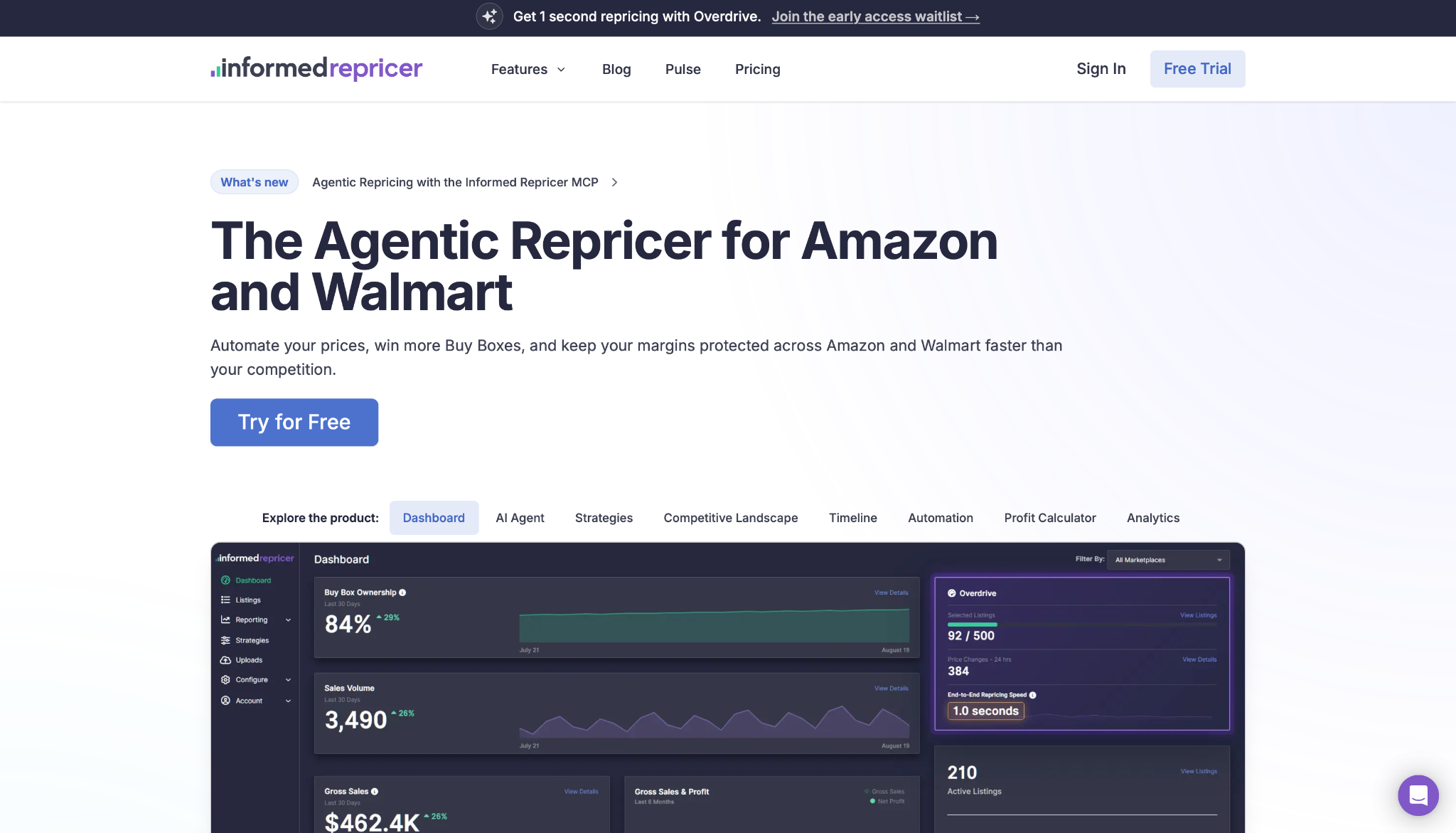
Informed Repricer is the only tool in this comparison that publicly defines its speed metric as true end-to-end time: from Amazon's offer-change timestamp to confirmed marketplace acceptance. The Overdrive architecture delivers sub-2-second end-to-end repricing, with internal calculation averaging approximately 70 ms. That's the processing step alone, the rest of the window is Amazon's infrastructure, which no repricer can shortcut.
Overdrive uses Amazon's direct (Patch) API path for up to 500 selected listings, bypassing the batch feed queue. This matters because batch feeds, while capable of processing up to 1,500,000 price changes per hour, introduce queue delays that the direct path avoids. Sellers choose which 500 listings go on the priority path, the ones with the highest Buy Box churn, where every second of delay has a real cost.
For the rest of a catalog, Informed Repricer uses batch feeds efficiently within Amazon's rate limits. The two-track approach (priority direct + batch) means fast where it counts, without blowing through API budgets on low-competition listings.
Pricing is straightforward: Launch at $99/month, Pro at $199/month, with Overdrive as an add-on at $29/month and Overdrive Pro at $49/month. There's a 14-day free trial with no credit card required.
Questions to ask: Can you see confirmed acceptance timestamps per reprice event? How does Overdrive behave when multiple competing sellers are all on the direct path simultaneously?
Repricer.com

Repricer.com claims "sub-second updates" and reports processing 5 billion price changes per week. The volume claim is impressive, at that scale, the batch feed math works out.
What's less clear is whether "sub-second" uses the same start/stop points as the end-to-end definition. The marketing emphasizes the submission speed, not confirmed acceptance. That's a gap worth probing before signing up.
Questions to ask: Where does the sub-second clock start and stop? Can you see acceptance confirmation timestamps in the dashboard?
SellerSnap
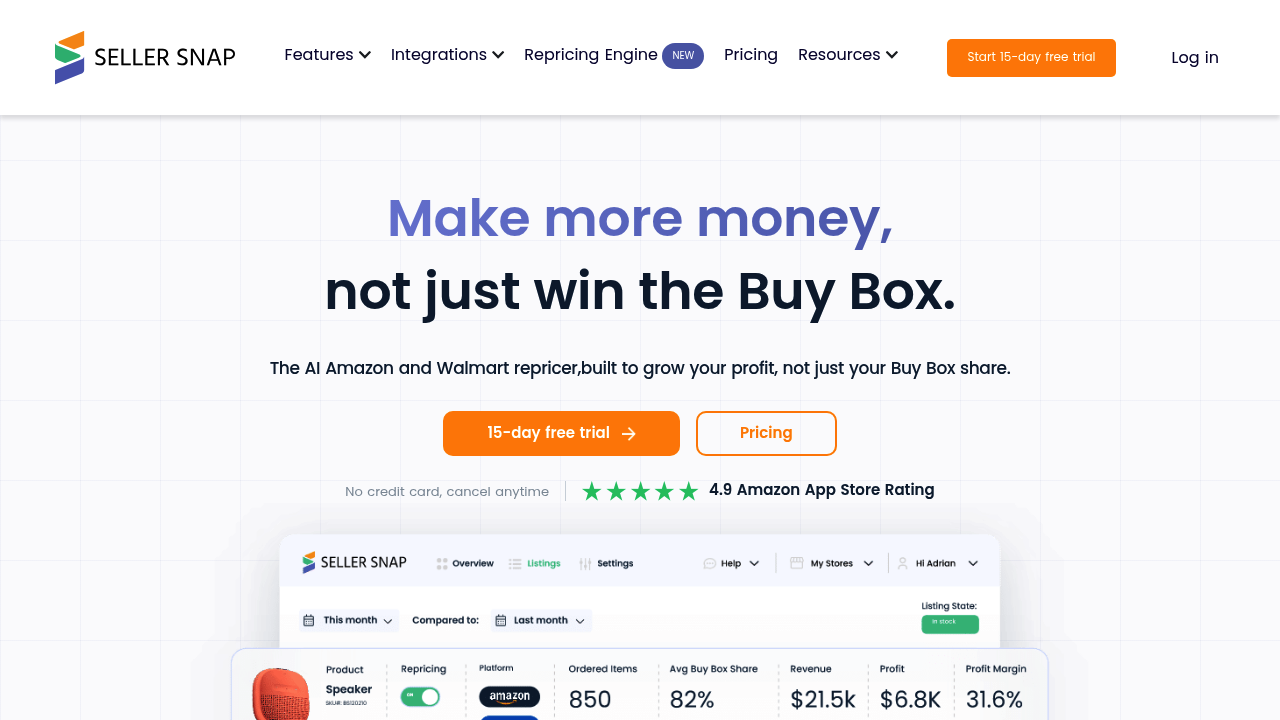
SellerSnap's AI-driven repricing approach and game-theory strategy engine earn it a Tier 1 spot. Its speed positioning, however, hasn't been updated with objective benchmarks, its primary "fastest Amazon repricer" content dates to October 2020 and doesn't define timer start/stop points or include end-to-end measurement methodology and pre-dates the availability of direct updates.
The underlying infrastructure is solid, and the AI strategy layer is genuinely differentiated. But sellers who want to audit speed claims won't find that transparency here.
Questions to ask: What is the current end-to-end benchmark? How does repricing frequency hold across a 5,000+ ASIN catalog?
Aura
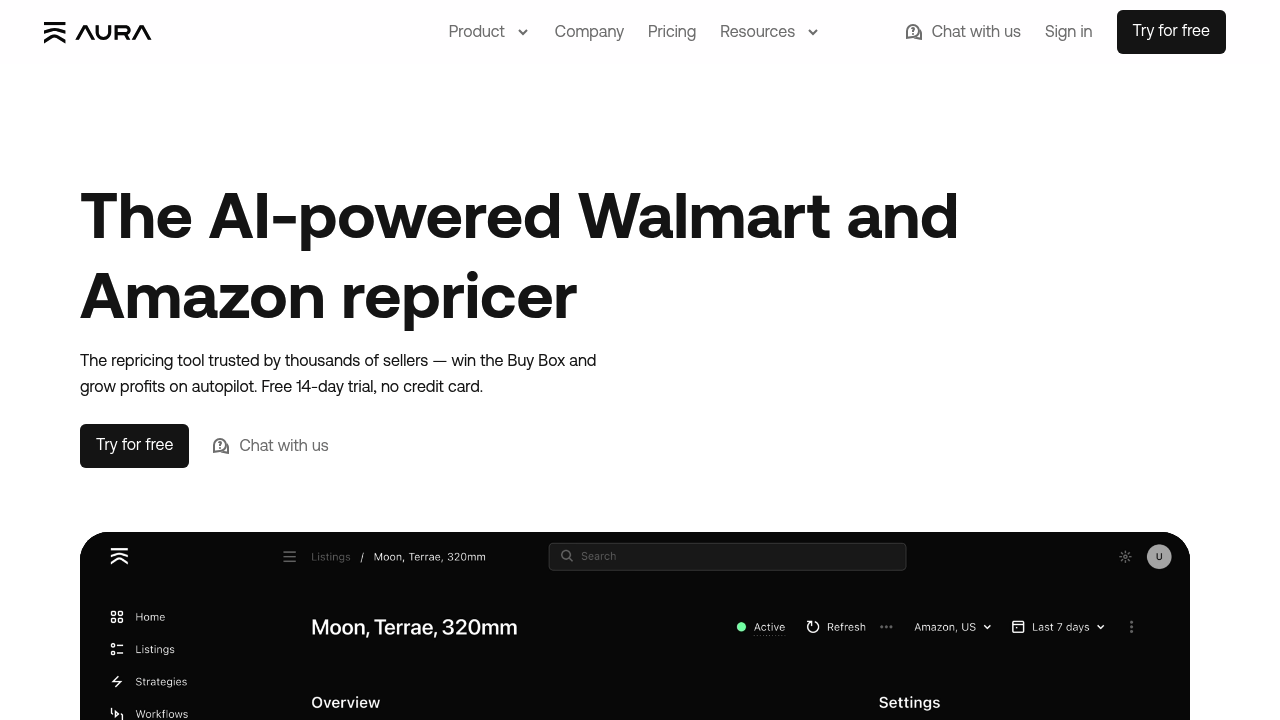
Aura (via its Hyperdrive feature) is a credible Tier 1 contender with a well-regarded user experience and a focus on Buy Box outcomes over raw speed metrics. Hyperdrive is marketed as the fastest repricing path Aura offers, but public documentation on exactly how end-to-end timing is measured is limited.
Questions to ask: What does Hyperdrive measure and how is marketplace acceptance confirmed? How does Hyperdrive perform across a large, mixed catalog?
Tier 2: Amazon Automate Pricing and Walmart Repricer
Native marketplace repricers get a dedicated tier because they're a fundamentally different product category. They're not slow because they're poorly built, they're rate-limited by the same API constraints that govern every third-party tool, with no priority path on top.
Amazon Automate Pricing runs entirely within Amazon's seller infrastructure. It doesn't use a separate direct-update path. It can't prioritize specific ASINs for faster processing. During peak competitive churn, the moments when speed matters most, it responds at the same rate as batch feeds, with no architectural fast lane.
The trade-off is real: setup is simpler, there's no additional subscription cost, and for sellers with low-competition catalogs, the speed ceiling never gets tested. But any seller competing in high-churn categories will hit the ceiling.
Walmart Repricer faces the same structural issue, compounded by Walmart's tighter rate limits: direct updates are capped at just 100 requests per hour. For a seller with 500 active Walmart listings, that's 100 prioritized updates per hour maximum on the direct path.
Use native tools if you're testing the waters or managing a small, low-competition catalog. Switch to a third-party tool once Buy Box churn and the simpler feature-set becomes a daily problem.
Tier 3: Flashpricer, bqool, and budget repricing tools
Budget tools land at the bottom not because they're dishonest, but because they lack the architectural transparency and portfolio consistency that Tier 1 tools demonstrate.
The common failure mode is timer selection: showing an impressive best-case number (often a single listing on a quiet API window) without explaining how that number degrades across a full catalog during peak hours. When API rate limits are shared across all customer accounts, a repricer processing many sellers simultaneously will deliver slower average response times than a single-listing test implies.
bqool, for example, markets "instant repricing" without a published definition of what "instant" means relative to the offer-change-to-acceptance window. Flashpricer's self-authored comparison content places itself first with speed claims that can't be independently audited.
For sellers with a handful of low-competition ASINs and a tight budget, these tools may be sufficient. For anyone competing for the Buy Box on high-volume listings, the lack of measurement transparency is itself a risk.
Side-by-side scoring
| Tool | End-to-end metric clarity | Timer start/stop defined | Speed architecture documented | Portfolio consistency | Amazon + Walmart | Verdict |
|---|---|---|---|---|---|---|
| Informed Repricer | Yes (offer-change → acceptance) | Yes | Yes (Overdrive, 500-listing priority path) | High | Yes | Best for speed consistency + margin protection |
| Repricer.com | Partial | Partial | Yes (AWS native) | High | Limited | Best for high-volume Amazon sellers |
| SellerSnap | Partial | No | Yes (AI engine) | High | No | Best for AI strategy + game theory |
| Aura | Partial | Partial | Yes (Hyperdrive) | High | No | Best for UX + Buy Box focus |
| Amazon Automate Pricing | No | No | No priority path | Medium | N/A | Good for simple/low-volume Amazon catalogs |
| Walmart Repricer | No | No | No priority path | Low | N/A | Good for simple/low-volume Walmart catalogs |
| Flashpricer / bqool | No | No | Not documented | Low | No | Budget option for low-competition niches |
Scoring prioritizes vendors that define confirmed acceptance as the endpoint and provide enough architectural detail to audit claims independently.
How to test any repricer's real speed in your own store
No vendor benchmark substitutes for a test on your own catalog. Here's a repeatable method:
- Pick 5-10 ASINs with high Buy Box churn, listings where you frequently lose and regain the Buy Box within a single day.
- Note the timestamp of a competitor's offer change (visible in your repricer's event log or via Amazon's SP-API).
- Record when your new price appears as the confirmed accepted price in Amazon Seller Central.
- The gap between those two timestamps is your real end-to-end time.
- Run this test across multiple days and multiple competitive events to get an average, not a best case.
Metrics worth tracking: time-to-acceptance per event, how often the repricer hits rate limits (watch for feed submission errors), and shopper-visible price change latency versus Seller Central acceptance timestamp.
Set profit floors before you run this test. The goal isn't to find out how fast you can drop your price, it's to find out how fast you can respond to a competitor's move while staying inside your margin boundaries. Speed that erodes margin is worse than no speed at all.
FAQ
Does "millisecond repricing" mean my offer updates in milliseconds?
Millisecond claims almost always refer to internal calculation time, how long the software takes to decide on a new price. Informed Repricer's internal calculation step, for instance, averages around 70 ms. But that's one step in a longer chain. Marketplace acceptance adds time that no repricer controls, and the end-to-end window is measured in seconds, not milliseconds.
Why do some repricers look faster in comparison tests?
Two reasons: timer selection and best-case framing. If a vendor stops the clock at "API call submitted" rather than "marketplace acceptance confirmed," their number will always look better. And if the test uses a single ASIN on a quiet hour, it won't reflect how the tool performs across a full catalog at peak competitive churn.
Can native tools (Amazon Automate Pricing) ever match third-party speed?
They operate under the same API rate limits as every third-party tool. What they don't have is a priority direct-update path for high-churn listings. During periods of heavy competition, they'll respond at batch-feed speed with no architectural way to escalate specific listings. Third-party tools that implement a direct-path priority tier (like Informed Repricer's Overdrive) can respond faster on those listings specifically.
How many listings should be on the priority path?
Only the ones where Buy Box churn actually costs you sales. Informed Repricer's Overdrive supports up to 500 listings on the direct-update path, a deliberate limit that keeps the priority path functional rather than diluted across an entire catalog. If you put 5,000 listings on a "priority" path, none of them are actually prioritized; you've just created a slower batch.