
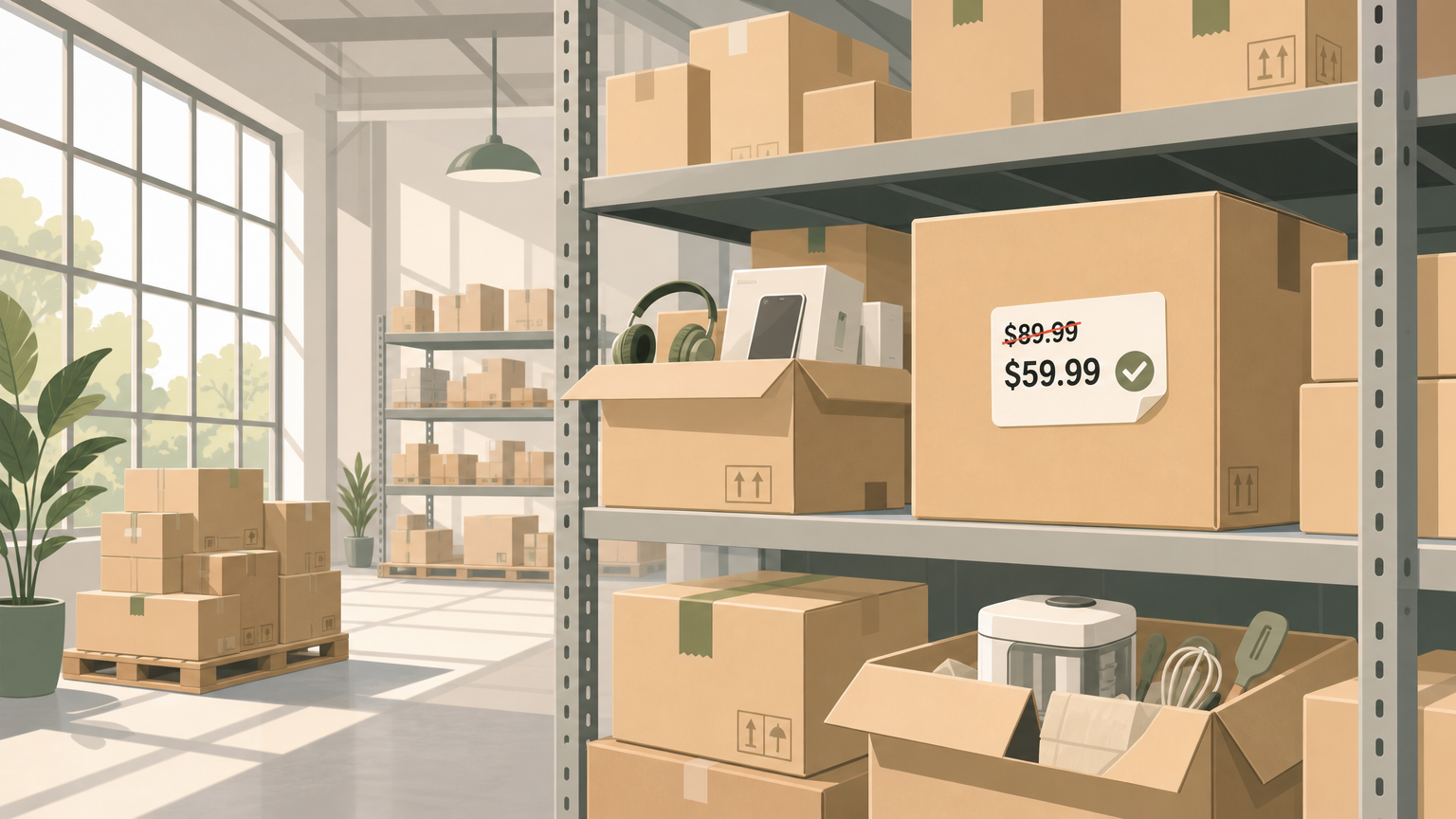

What Amazon actually evaluates before awarding the Featured Offer
Amazon stopped calling it the "Buy Box" in seller-facing documentation and now refers to it as the Featured Offer, the prominent "Add to Cart" placement on a product detail page. The name change matters because it signals how Amazon frames the selection: it's about which offer is best for the customer, not which seller bid the lowest price.
Amazon evaluates a set of offer attributes when deciding which seller's listing occupies that Featured Offer slot. Price is one input. Fulfillment method (FBA vs. FBM), shipping speed, seller feedback rating, order defect rate, inventory availability, and account health metrics all factor in. A repricing tool can only directly influence one of those variables, price, but because price is often the deciding factor when two otherwise comparable offers compete for the same slot, managing it systematically produces measurable lift in Featured Offer win rate.
The goal of amazon repricing software isn't to get to the lowest price. It's to get to the right price: one that improves Featured Offer probability without sacrificing more margin than necessary to win.
How repricing software actually works: the system mechanics
Understanding how repricing tools operate helps sellers configure them intelligently rather than treating them as a "set it and forget it" black box.
Ingestion: reading the competitive landscape at the SKU level
A repricer continuously pulls offer data for every SKU in a seller's catalog. This includes the competing offers on the same ASIN, their prices, fulfillment types, seller ratings, and Featured Offer status. Informed Repricer's Instant Repricing feature is designed to detect competitor price changes and react within seconds, which matters in categories with fast-moving competitive dynamics.
At the SKU level, the system tracks: your current price, your min/max guardrails, the competitive offer set, and the current Featured Offer holder. That state snapshot is the foundation for every repricing decision.
Decisioning: translating strategy logic into a price target
Once the repricer has an updated offer state, it applies a configured strategy. Common strategy types include:
- Competitive undercut logic: Price just below the lowest competing FBA (or all) offer to improve Featured Offer probability.
- Match logic: Price at parity with the Featured Offer holder when you already have competitive account health metrics.
- Upward repricing (reprice upwards strategy): When you already hold the Featured Offer and no competitor is close, raise price to a higher point within your max limit, capturing additional margin without losing the slot.
- Algorithmic/Optimal Price: A machine learning-based approach that factors in conversion probability and margin impact across historical patterns, rather than simply chasing a competitor's price.
The decisioning layer is where most sellers under-invest. Choosing only "undercut by $0.01" without conditions means the repricer will always race downward, even when no competitive pressure requires it.
Constraints: min/max guardrails and margin floors
Repricing rules min/max guardrails are the safety net. Every rule should have:
- A minimum price (floor) that reflects your landed cost plus an acceptable margin. The repricer will never go below this, regardless of competitive pressure.
- A maximum price (ceiling) that sets the upper bound, useful for price-sensitive categories and for preventing accidental overprice spikes.
Without a well-configured floor, a competitive undercut rule can trigger a price war that destroys margin before any meaningful Buy Box data accumulates. With it, the repricer simply stops adjusting when the floor is reached, protecting you while the price war plays out below your threshold.
Execution and feedback loop
Once a target price is calculated, the system pushes the update through Amazon's pricing update mechanisms. The feedback loop closes when the repricer pulls updated Featured Offer data and reports whether the price change produced a status change. That reporting layer, what Informed Repricer calls Actionable Insights, is what allows sellers to evaluate rule performance and adjust strategy rather than guessing.
Amazon Automate Pricing vs. third-party repricers: what's different
Amazon's own "Automate Pricing" tool (available via Seller Central, described at sell.amazon.com/tools/automate-pricing) offers three rule categories: competitive price-based rules, sales-based rules, and business price rules. Amazon positions this as a way to maximize sales potential through the Featured Offer and save time on manual adjustments.
The native tool works. For sellers with small catalogs and straightforward competitive environments, it covers the basics. Where it has documented gaps: strategy depth, upward repricing logic, profit-based guardrails, and analytics reporting.
Here's how the options stack up across the features that matter most for buy box ownership strategy:
| Feature | Amazon Automate Pricing | Informed Repricer | Typical third-party repricers |
|---|---|---|---|
| Competitive price-based rules | Yes | Yes | Yes |
| Sales-based rules | Yes | Yes | Varies |
| Business price rules | Yes | Yes (Business Repricing) | Varies |
| Min/max guardrails | Basic | Configurable with margin floors | Generally yes |
| Reprice upwards / hold logic | Limited | Yes (Smart Algorithms) | Often yes |
| Algorithmic / ML-based pricing | No | Yes (Smart Algorithms) | Varies |
| FBA vs. FBM differentiation | Limited | Yes | Generally yes |
| Reporting / insights depth | Basic | Actionable Insights dashboard | Varies |
| Response speed | Minutes to hours (reported) | Seconds (Instant Repricing) | Seconds to minutes |
| Live support | No | Expert Live Chat Support | Varies |
The practical gap is most visible in two situations: when you want to raise price without losing your Featured Offer position, and when you need to diagnose why a price change didn't produce a Featured Offer change.
Case study 1: competitive repricing with FBA vs. FBM competition
Note: The following is a modeled scenario based on commonly observed patterns in competitive repricing deployments. Specific customer data was not available for this publication.
Situation: A mid-size US seller with approximately 400 active SKUs across household and kitchen categories. The majority of their listings competed against 3-6 other sellers, a mix of FBA and FBM. Featured Offer win rate was running around 41% measured over a 30-day baseline before any repricing software was active.
Configuration used:
- Strategy: "Get The Buy Box", competitive undercut targeting FBA offers only (FBM offers excluded from competitive target due to slower shipping disadvantage already priced into selection algorithm)
- Min price: set at landed cost + 12% margin per SKU
- Max price: set at 15% above the 90-day average sale price
- Response to tie: match rather than undercut (avoids unnecessary margin loss when parity is sufficient)
What happened over 30 days:
In the first week, the repricer adjusted prices on 212 SKUs, mostly small reductions of $0.30-$1.50. Featured Offer win rate moved from 41% to 58% by day 10. On day 14, a large competitor dropped prices sharply on 80 overlapping SKUs. The repricer responded, hitting min-price floors on 23 of those SKUs rather than following the competitor below the floor. On those 23 SKUs, Featured Offer was lost temporarily but margin was protected. By day 28, the competing seller had reverted pricing on most of those SKUs (a common pattern when automated undercut strategies hit unsustainable levels). The repricer then raised prices back toward max limits using hold/raise logic.
30-day results:
- Featured Offer win rate: 41% → 63%
- Units sold: +29% vs. prior 30 days
- Gross margin: down 3 percentage points on the 23 SKUs that hit min floors during the price war; up 1 percentage point overall due to upward repricing on clear-hold SKUs
Lessons learned: FBM exclusion from the competitive target was the most impactful single configuration choice. FBM sellers often price lower because they have lower fulfillment cost structure on certain heavy items, but Amazon's algorithm still tends to favor FBA sellers with comparable prices. Competing against FBM on price alone often meant unnecessary undercutting that provided no Featured Offer benefit.
Case study 2: reprice upwards to protect margin without losing Featured Offer
Note: Modeled scenario based on documented repricing behavior patterns.
Situation: A seller focused on home improvement, running primarily private label SKUs where they were the only FBA seller on most listings. Their original rule was a simple "match lowest price" configuration. Gross margin was eroding because the rule was periodically matching irrelevant low-quality FBM listings.
Configuration change:
- Strategy switched to profit-based / Optimal Price algorithm
- Upward repricing enabled: when seller holds Featured Offer and no competitive FBA offer is within 8% of current price, raise toward max limit in increments
- FBM offers below a seller feedback threshold excluded from competitive matching
- Min price: cost + 18% target margin
Timeline pattern observed over 60 days:
Weeks 1-2: Algorithm raised prices on 67 SKUs where the seller was already holding the Featured Offer with no nearby competition. Average price increase on those SKUs: 6.8%. Featured Offer retention rate: 97% on raised SKUs (3% experienced a new FBA entrant who then held the slot briefly).
Weeks 3-4: Two competitor FBA sellers entered several overlapping ASINs. Repricer detected the entries and adjusted downward on 31 SKUs. Held price on 19 SKUs where the competitor's seller metrics were weak enough that parity was sufficient to retain the Featured Offer.
Weeks 5-8: Settled into a pattern of raising on ~40 SKUs per week and holding on ~15. Net margin trend moved up.
60-day results:
- Featured Offer win rate: stable, 71% → 74%
- Average selling price: +4.2%
- Gross margin: +6 percentage points vs. prior 60 days
Lessons learned: The upward repricing strategy works best when a seller has low competitive density on at least a portion of their catalog, and when FBM competitors are properly filtered. In categories with 8+ competitive FBA sellers per ASIN, price elasticity and competitive response speed tend to compress the windows where raising price is viable. The seller ultimately ran different strategy configurations by category, not a single rule across all SKUs.
Case study 3: when repricing didn't win the Featured Offer (and what that revealed)
Note: Modeled scenario illustrating a documented class of repricing failure.
Situation: A seller with 150 SKUs in electronics accessories. After configuring competitive repricing with correct min/max guardrails, Featured Offer win rate improved modestly on most SKUs, but on 40 SKUs, it didn't move at all despite consistent price adjustments. The repricer was working correctly. Something else was blocking the Featured Offer.
Configuration used:
- Competitive undercut targeting all FBA offers
- Min: cost + 10%
- Max: manufacturer's suggested retail price (MSRP)
- Updates processed multiple times per day
What the timeline showed:
Over 21 days, on the 40 non-responding SKUs, the repricer made 310 price adjustments. Competitor prices changed frequently. The seller's price was consistently at or below the lowest FBA competitor. But Featured Offer win rate on those SKUs stayed near zero.
Diagnosis (identified via Actionable Insights reporting):
The seller's account had an elevated late-shipment rate on FBM orders that predated their FBA transition. Those historical metrics were still depressing account health scores. On SKUs where a high-performing FBA competitor existed, Amazon's algorithm was selecting that competitor despite the price advantage. On three ASINs, the product listings had a condition flag issue that suppressed the Featured Offer entirely regardless of price.
Outcome: The seller paused aggressive repricing on the 40 flagged SKUs, which stopped unnecessary price erosion. They addressed account health metrics over the following 45 days. Featured Offer win rate on those SKUs improved from near-zero to 34% after account health recovered, without any further price changes.
Lessons learned: If Featured Offer win rate doesn't respond to price changes within 7-10 days of correctly configured repricing, price is probably not the primary blocker. Common non-price blockers include: account health/ODR issues, listing suppression, condition mismatches, and inventory availability flags. The right move is to pause aggressive price changes (which erode margin without any upside) and investigate the actual cause.
Getting started: the minimum rule set to begin responsibly
Before scaling repricing across a full catalog, validate the system on a test set of 20-30 SKUs that represent different competitive dynamics: some where you're the only FBA seller, some with 3-5 FBA competitors, and some with mixed FBA/FBM competition.
Minimum starting configuration:
- Set a minimum price for every SKU based on landed cost + minimum acceptable margin (not a round number applied catalog-wide, calculate per-SKU or per-category)
- Set a maximum price at a level that reflects realistic market pricing for each SKU
- Choose a starting strategy: "Get the Featured Offer" competitive targeting is the most common entry point
- Configure FBA/FBM differentiation: decide whether your competitive target includes FBM offers and at what threshold
- Enable upward repricing or hold logic from day one, without it, the repricer will constantly try to undercut even when you already hold the Featured Offer
Validation checklist before scaling:
- Confirm the repricer is responding to competitor price changes on test SKUs (check the activity log within 30 minutes of a known price change)
- Verify minimum price floors are being respected (manually check 5 SKUs against your cost sheet)
- Establish baseline metrics for the test set: Featured Offer win rate %, units/day, and gross margin, you need these to measure impact
- Set a review cadence: check Actionable Insights data at day 7 and day 14 before expanding
Informed Repricer's Expert Live Chat Support is available to help with initial configuration decisions, which reduces the time from setup to validated performance.
Mistakes that cost sellers margin and Featured Offer share
Min/max ranges set too wide. A $5 minimum on a product that costs $18 isn't a guardrail, it's a race to the bottom with a delayed starting gun. Set floors based on actual cost data.
Undercutting before you have performance data. Aggressive repricing in the first 7 days, before any Featured Offer baseline is established, makes it impossible to know what's working. Start with match logic, establish the baseline, then adjust.
No measurement baseline. If you don't know your Featured Offer win rate before enabling a repricer, you can't attribute changes to repricing vs. seasonal demand, competitor catalog changes, or account health fluctuations. Log the baseline first.
Treating FBA and FBM competition the same. FBM sellers are already penalized in Amazon's selection algorithm for slower shipping on most categories. Automatically undercutting them wastes margin on a competitive threat that often doesn't require a price response.
Skipping hold/raise logic. A repricer that only moves prices downward will eventually hit your floor on every competitive SKU and stay there. A repricer that also holds or raises when conditions allow it protects margin and keeps pricing dynamic.
Questions sellers ask before choosing repricing software
How fast does repricing need to be to matter? Speed matters most in high-velocity categories where Featured Offer status changes multiple times per day. In slower categories, a response window of several minutes may be adequate. The practical floor is: fast enough to respond before the competitor's repricing cycle runs again. Informed Repricer's Instant Repricing is designed to respond within seconds of detecting a competitor change.
Will repricing guarantee the Featured Offer? No. Price is one factor. Account health, fulfillment method, shipping speed, and listing status all affect selection. Repricing improves your probability when price is the binding constraint.
Is it safe for margins? With correctly configured min/max guardrails and profit-based strategy logic, yes. The risk comes from running repricing without a floor, or from setting the floor incorrectly. Both are configuration errors, not inherent risks of the approach.
How do I prevent destructive price wars? Set a minimum price floor you're willing to hold at and won't undercut. When a competitor drops below that floor, let them. Don't follow. Monitor which SKUs consistently hit the floor, those are your candidates for reviewing competitive strategy, not for continuing to chase.
What should I monitor weekly? Featured Offer win rate by SKU group, average selling price trend, gross margin vs. prior period, and the number of SKUs currently at min-price floors. If floor-hits are increasing, your catalog is entering a more competitive phase and strategy adjustments are likely needed.
For sellers on both Amazon and Walmart, Informed Repricer's platform covers both marketplaces, so the same strategic logic, knowing when to lower, hold, or raise, applies across channels without managing two separate systems.